
SI: Slovensko verzijo Maribor walking tour-a oz. samo-peški-vodenja po Mariboru najdeš tukaj: Maribor vodenje.
ES: Puedes encontrar la versión en español aquí.
You live in Maribor, maybe you found yourself here by accident, maybe you came to explore our beautiful city, or maybe it’s something else entirely. But now you’re here – and you want to make a tour of the inviting Styrian capital. Say no more! You can walk around the second largest Slovenian city with me.
Duration: 1.5 h
Destinations: TIC Maribor – Liberty Square – Castle Square – Volkmer passage – Gosposka Street – Jewish Square – Lent (Usnjarska street-Old Vine-Museum of the oldest vine in the world-Žički Passage) – Main Square– Poštna Street – Slomšek Square
When you see a human emoji, it means that you are moving somewhere 🚶♀️🚶♂️, and a candy 🍬 indicates a particularly interesting fun fact waiting for you. And a short orienteering lesson. If you stand at the starting point (the entrance of TIC behind your back, and the entrance of the red church in front of you), you are facing west. To the left/down/south there are the Drava river and Pohorje, behind you/east are the TIC and the railway station. and right/up or in the north the Maribor city hills.
🗺️ And just so that no one gets lost, here are two more Google Maps. The first one being from TIC Maribor to the Jewish Square (or GT22), and the second from Lent to Slomšek Square.
MARIBOR
We open the first map.
Where are you anyway? As mentioned, Maribor is the second largest city in Slovenia and the largest city in the Slovenian region of Styria. It has around 120,000 inhabitants and is the economic, administrative, educational and cultural center of eastern Slovenia.
Maribor was first mentioned as a castle in 1164, as a settlement in 1209, and slightly after that as a city – in 1254. Let’s rewind a few centuries into the future. Like most of the Slovenian territory, the city was ruled by the Habsburgs until 1918, when Rudolf Maister and his fighters made sure that we can still speak the beautiful Slovenian Styrian here today. Then we lived in various Yugoslav state formations, and in 1991 we officially became part of the independent Republic of Slovenia.
And now we start our nice walk exactly at the Tourist Information Center or TIC Maribor. You can visit the information point here, fetch a map of the city for the journey ahead of you and also note, there is a free toilet available at the center.
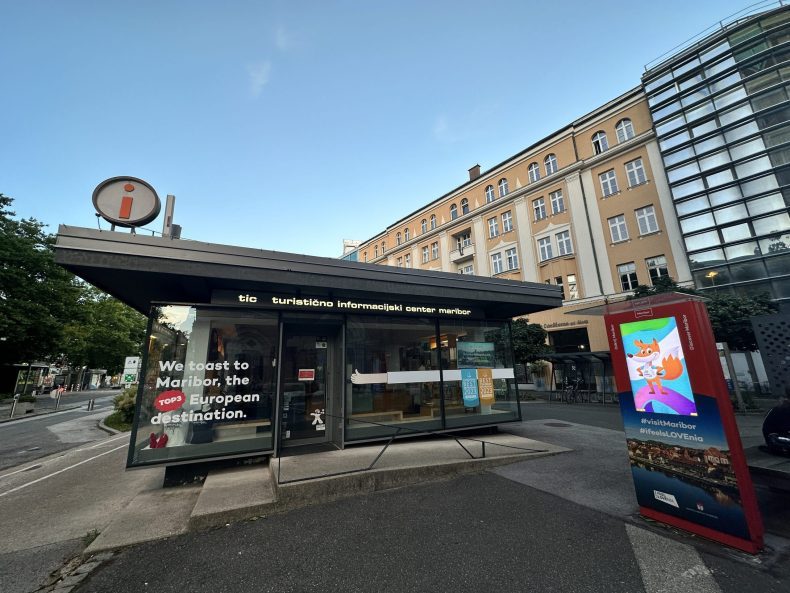 TIC Maribor – where you can get information and maps.
The Franciscan Church
And it’s time for the honorable first point of this fun wagon: in front of the TIC we see the pearl of Maribor architecture and (in my opinion) one of the most beautiful churches in Slovenia – our beautiful red church. The Franciscan Church or Basilica of the Mother of Mercy was completed in 1900. On the south side, a two-story Franciscan monastery is adjoined to the church, and both are covered with signature red brick. Inside the church, we find 7 altars and a statue of Mary of Grace from the beginning of the 18th century. There is nothing more beautiful than lighting candles under Mary’s kind gaze. Would recommend.

🍬 The women of Maribor from the turn of the 19th to the 20th century are some of the many responsible for the charming brick appearance of the church today. They brought these countless bricks from nearby Melje. And since nothing is free, they were paid for it with indulgences.
#1 LIBERTY SQUARE
🚶♀️🚶And now to the Liberty Square, one of Maribor’s many city squares. The square is located in the eastern part of the Maribor City Castle (again – for the original Maribor orientation, we know that the Pohorje hill and the Drava river are in the south). The city gate once stood here with a drawbridge over the moat, and after it was filled in, a castle garden was created on this site. And now, all the way back since 1863 the square, as we know it today, has reigned here.

🍬 20 years after the opening of the square, in 1883, the Habsburg emperor Franz Joseph was welcomed here, and in 1919, a parade of the then Slovenian army was held here under the leadership of General Rudolf Maister.
The square is decorated with a bronze monument to the national liberation struggle, better known by the locals as “Kojak“. The ball is reminiscent of the headless detective Kojak from the once popular series of the same name. Kojak commemorates almost 700 hostages and rebels who were killed by German forces during the national liberation struggle for attempting to resist the occupation. On the monument, among other things, we see copies of proclamations about the shooting of hostages and rebels during the Second World War and a farewell letter on the death of convict Jože Fluks. At this point, I should point out that (despite itspractical shape) it is not polite to walk on monuments.

At the northeastern end of the square (or the greater part below it) is the Vinag winery, one of the largest and oldest classical wine cellars in Europe. It boasts an area of 20,000 m2 and 2.5 kilometers of underground tunnels. The greatest treasure of the cellar is the wine archive, where they store more than 250,000 bottles of the finest vintages.
#2 CASTLE SQUARE
🚶♀️🚶♂️Let’s walk a few steps along the castle, towards the west, where the lively Castle Square is already opening. We stop at the column of Florian’s monument. But first, to the beauty that gives the square its image – the Maribor Castle.
Maribor Castle
The Maribor Castle was built by Emperor Frederic III. in the 15th century for the purpose of strengthening the city walls, which once ran here (remember the ditch from a little earlier). The oldest part of the castle is preserved in its basic form even today, but the original Gothic appearance was changed by later reconstructions into the current iconic appearance.

Once the most powerful building in Maribor, currently hosts the Maribor Regional Museum. And since Maribor has always been the place to be, Maribor Castle has hosted many famous personalities throughout the centuries:
- the famous pianist Franz Liszt gave a concert in the knight’s hall,
- quite a few crowned heads visited the castle, including Leopold I., Charles VI., the Russian heir to the throne and later Tsar Paul I., and in all probability also the Habsburg monarch Maria Theresa,
- Pope Pius VI spent the night in the castle. and
- during the German occupation of Maribor at the outbreak of World War II, Adolf Hitler also visited the castle.
Florian Monument
Just below the castle we see the baroque figure of St. Florian, the patron saint of firefighters, who has been protecting the city from fires on a tall pillar since the 18th century. In the past, embers of fire meant a great danger to the city, as the townspeople’s houses were made of wood and built close to each other.
Ezl Ek
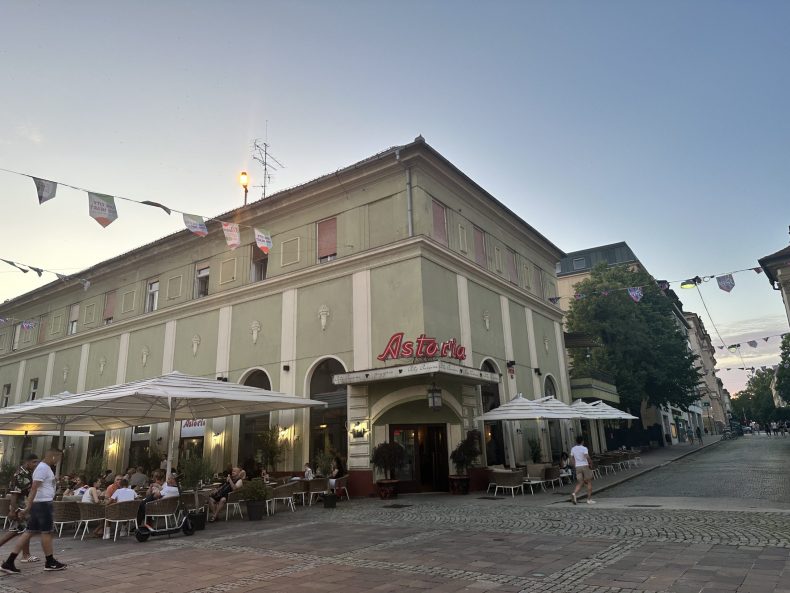
The view of the green building vis-a-vis the western side of the castle (Cafe Astoria) offers us a view of the once popular “donkey corner”, Ezl ek. Where we can now see the entrance to the cafe, was once the hottest corner of Maribor. After the Second World War, all generations began to meet here – ezl ek was the point where people came to show themselves to others. If the girls bought a new dress or shoes, they had to pass by ezl ek and show off their new acquisitions, and this corner is -above all- known for many kisses and first loves. And it is probably the only corner in the city that has an entire song written about it. 🍬To bil je ezl ek …
The First Lightbulb
A few steps 🚶♀️🚶♂️ to the south of the square, on the facade of the building next to the tobacco shop, we see a plaque with a light bulb. Only four years after Edison’s invention, the modern light bulb lit up in Maribor, on April 4, 1883. This type of light bulb was not only the first in Maribor, but also in all of Slovenia and in this part of Europe.

🍬 NIKOLA TESLA
Believe it or not – after leaving his studies in Graz, the great inventor Nikola Tesla spent some time in Maribor. Here, he worked at an engineer while his family did not know where he was and even thought him dead for some time. He spent most of his time in Maribor gambling and ended up being deported from the city because he did not posses a residence permit. The town authorities decided »that the aforementioned Nikolaus Tesla, with no disposable financial means on his person to support himself, be deported from Marburg to Gospić, where he should seek workˮ.
Hotel Orel
We cross the square 🚶♀️🚶♂️ and walk along the Volkmer passage. It is dominated by the Hotel Orel, which used to be known as the best restaurant in town. Once called the Schwarzer Adler (Black Eagle), it was famous for hosting foreign guests and many big names such as Ray Charles and even our Yugoslavian President Josip Broz Tito.

#3 VOLKMER PASSAGE
And further 🚶♀️🚶♂️ along Volkmer’s passage to the monument of clenched fists, which commemorates the fact that Maribor was the first major Slovenian city to be captured by German occupation forces in 1941. However, the conscious residents of Maribor did not accept this easily. The first insurrectionary action in both Yugoslavia and Slovenia took place right at this crossing, on April 29, 1941 – just three days after Hitler’s visit to Maribor.
A group of young people set fire to two German cars during the night curfew, and the occupier never found out who was responsible.

#4 GOSPOSKA STREET
🚶♀️🚶♂️ We turn from the passage and we are already on the most famous street in Maribor, Gosposka Street or the Gentlemen’s Street. Once the most lively street in the whole city, it remains the central street of Maribor, and was first mentioned in 1488. We walk past the bars and shops and continue the path 🚶♀️🚶♂️ to the south.

#5 JEWISH SQUARE WITH THE SYNAGOGUE
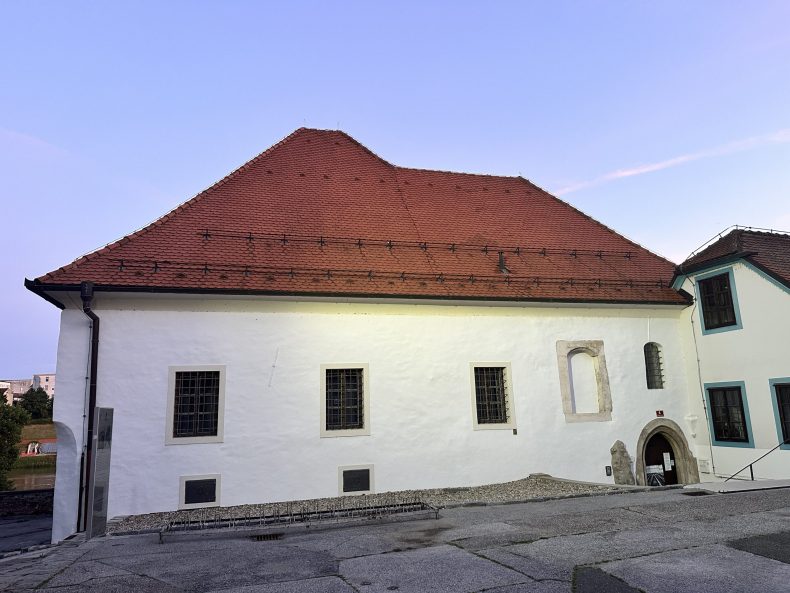
We arrive to the Jewish Square, the center of the medieval Jewish quarter of the city. Jews immigrated to Maribor in the second half of the 13th century and shortly after their arrival in the city, they developed a lively trade and became an important part of the city’s economy. For religious needs, a synagogue was built (at the latest) in the 15th century, and is one of the most important Jewish monuments in our country, as well as one of the oldest synagogues in Central Europe. After the expulsion of the Jews in 1497, it served as a Roman Catholic church, later as a residential building, and today it houses the Center of Jewish Cultural Heritage.
🍬 After being deported out of Maribor, the Maribor Jews often named themselves after the city they came from. Thus, today variants of surnames such as Marpurgo or Morpurgo are found in countries like Italy, the United States of America, and Israel.
As part of the Jewish Square, there is also the Jewish Tower, which can be seen in the eastern part of the square. It was built in the 15th century and was once a defensive part of Maribor’s city walls. 🍬The walls are 1.5 meters thick and are made of stone in the lower part and brick in the upper part.
🍬 And speaking of towers – with the view of the Drava, we can see another tower on Lent – the Water Tower. The water tower, a mighty Renaissance fortress with an unusual shape, once defended the walls of Maribor, but today it serves as a wine cellar.

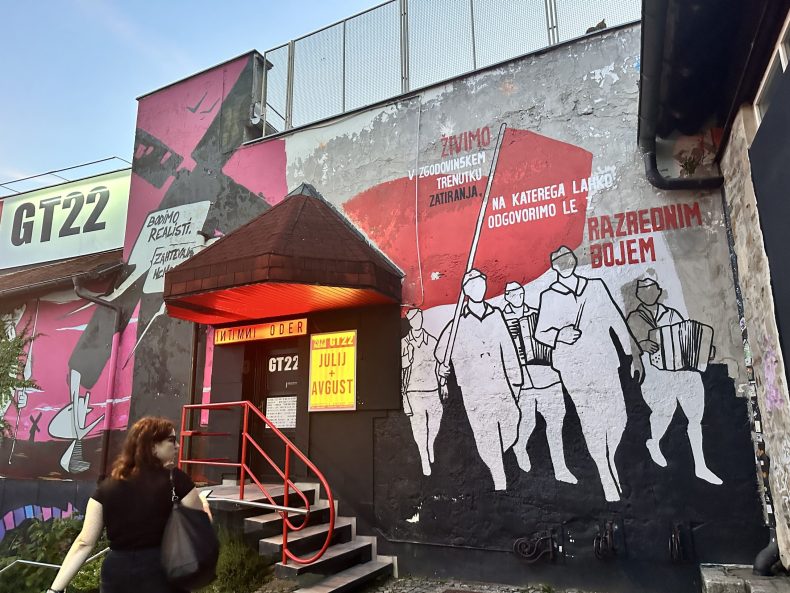
At this point, we walk to GT22 (pictured below), continue our journey down the stairs towards Lent, turn on the second map (because Google seems to dislike stairs), find ourselves at the graffiti “An eye for an eye, toothpaste for teeth” (address Usnjarska ulica 5) , and we continue our journey towards the next stop – the Old vine.
#6 LENT
And a short descent has already brought us 🚶♀️🚶♂️ to the Drava river, and one of the oldest parts of the city of Maribor, Lent. The name Lent comes from the German word länder, which means “the landing area”. This was once an important port for the landing of river rafts.
The Old Vine House
Our first Lent stop is the Old Vine House, on the facade of which grows the oldest vine in the world. In 2004, this was entered in the Guinness Book of World Records as the oldest of all the still wine-bearing vines in the world, as experts estimated that it is more than 450 years old. It is one of the oldest domestic vine varieties in Slovenia, called modra kavčina or the velvet black. It is harvested every year by the town’s winemaker, and the wine is used for ceremonial municipal gifts.
Visiting the interior of the Old Vine House is completely free, and there you can also decide on a tasting.
🍬 A little to the west of the Old Vine House, we can also find the Court Tower, another of the memories of the former city walls. It was built as a defensive tower in the 14th century, and throughout history it has been added to several times. Despite its name, it was used mainly for defense purposes, but later it also served as a warehouse and production facility. It is said to have been given its name by popular imagination, as some people still believe that witchcraft processes take place in the tower.
And one more 🍬. Maybe not here exactly, but witches were really persecuted in Maribor as well. Here, the witches were sentenced at the City Hall, and the Main Square, where the punishments were then carried out, was then decorated with a column of shame and a cage. Of course, the nearby Drava river was also a popular way to test witchcraft. And what were some of the crimes, persecuted here?Baking cakes made of vipers, lizards and toads, controlling the weather, and the like.
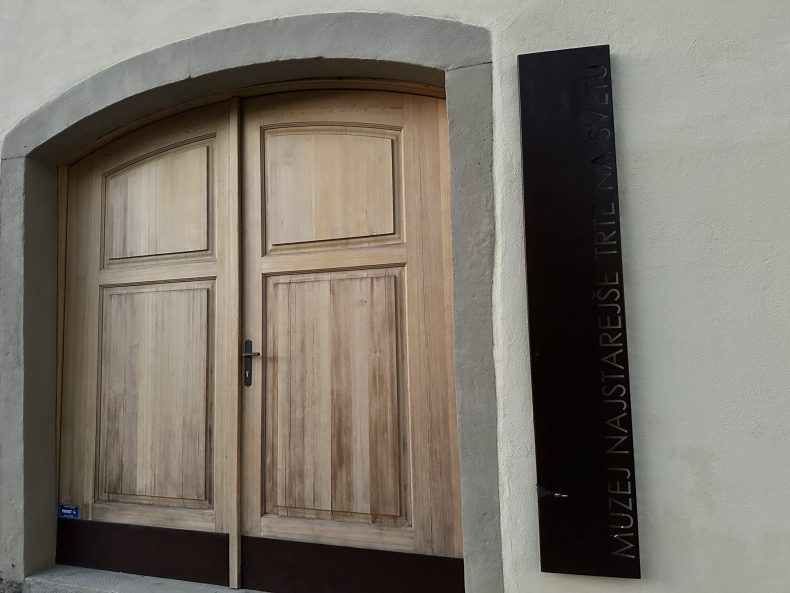
Oldest Vine Museum
🚶♀️🚶♂️ A few steps away from the Old Vine we also find the Oldest Vine Museum, dedicated to our venerable lady.
Žički Passing 5
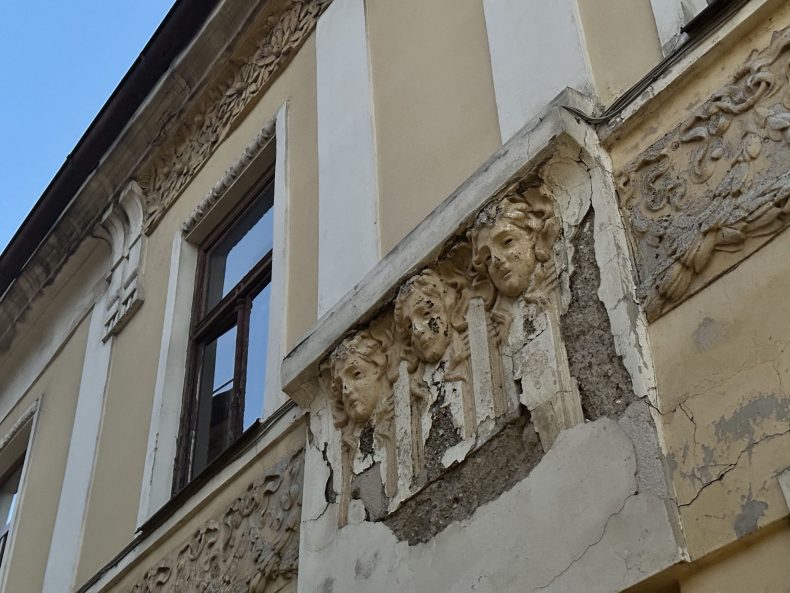
And a few more steps 🚶♀️🚶♂️ further to Žički passage 5. 🍬Can you believe that there were once more brothels operating in Maribor than in Slovenia’s capital? Above the entrance of the house at Žički prehod 5, we can still see the ornaments that hinted at the festivities that took place inside. The partying nature of the city was once reflected by the number of brothels – public houses. In the last years of the 19th century, Maribor boasted with more so-called tolerance houses than Ljubljana. There were two of them in the capital, and the people of Maribor could choose between seven of them!
#7 MAIN SQUARE
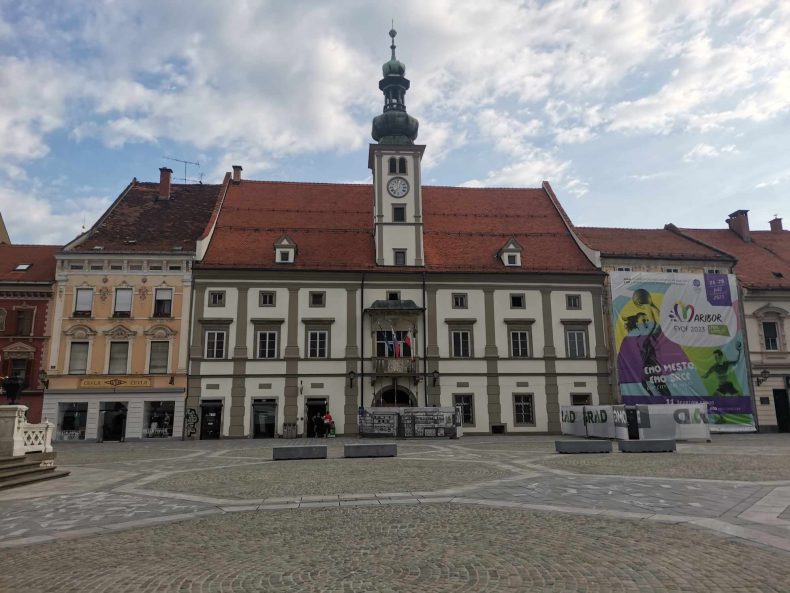
🚶♀️🚶♂️And we ascend the passage and arrive to the central square of Maribor, the Main Square. Let’s go right into the heart of the square and stop in front of the square’s central monument. The Main square was first mentioned in 1315 as Markt, and with the growth of the city in the 19th century it got its current name Hauptplatz – Main Square. For many centuries, until the Second World War, a lively trade took place there, as it was the central place in the city where farmers and artisans sold their produce and products.

Our town hall, better known as Rotovž, dominates the square without a doubt. It was built in 1515, and on the balcony we can see a relief decorated with the city coat of arms and two lions. 🍬If we look a little more closely, we notice that the tower is not located in the middle of the building. Skeptics say that this happened due to the rebuilding of the buildings, but the people of Maribor believe the legend that the tower was moved by disgruntled masters in protest after inadequate payment. Behind Rotovž, where we now see the construction site, is the Rotovž Square, which once hosted bullfights.
Another ruler of the Main Square is the Plague Column, placed in thanks at the end of the plague, which killed a third of the entire population of Maribor in the 17th century. The original monument was erected in 1683, and today it represents the statue of the Mother of God accompanied by six saints.
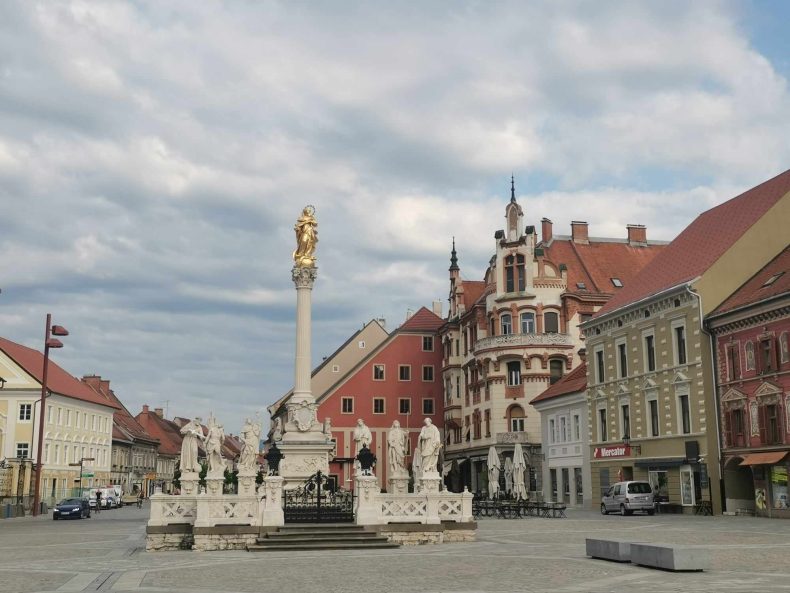
🍬In the beautiful red house, painted with pharmacy motifs (a few buildings west of Rotovž), there used to be the city pharmacy of the famous Maribor pharmacist Franco Minarik.
#8 POŠTNA STREET
🚶♀️🚶♂️ Poštna Street is one of the most popular and lively streets in Maribor. It especially comes to life on summer evenings, when the tables of bars are arranged along the entire street. A few years back, cars still drove along Poštna, but now something like that is nearly impossible to imagine. As we walk along the street, everything from fine wine bars to authentic Czech beer experiences, and slices of pizza invite us to stop there.

#9 SLOMŠEK SQUARE
After a walk along Poštna Street 🚶♀️🚶♂️ we find ourselves at the Slomšek Square, home of the Maribor Cathedral. The square is named after the blessed Anton Martin Slomšek, Maribor’s first bishop and a defender of Slovenian national culture, who did a lot for education and the development of Maribor. In front of the entrance to the church (which you can visit along with its tower), we can see the Slomšek monument.
The square was once called Kirchenplatz or Church Square – because of the oldest church in Maribor, St. John the Baptist. It was built in the 12th century and later enlarged. Today, the church has a Gothic appearance that dates back to the 19th century.
The current platform around the church was designed by the great Slovenian architect Jože Plečnik in 1983, and centuries before that the church was surrounded by a cemetery. Traces of the eternal abode can still be seen around the church. For example, a pillar with an eternal light that marks the cemetery from 1517 is still preserved today. Some tombstones are also preserved, and now built into the outer walls of the church. And the monument next to the eternal light? Another history remnant – an ancient Roman lion from the 2nd century!

The legendary Pope John Paul II also visited Slomšek Square in 1999, when he beatified our bishop Slomšek. Slovenians usually remember this important visit after Pope’s famous words, said in Slovene: “The Pope loves you!” (Papež ‘ma vas rad).
And the Maribor Walking Tour project is officially completed!
And we have come to the end of our Maribor walking tour. Of course, all this is only a part of the history and the present of our wonderful metropolis. In the future – we will surely tackle some more in-depth touring of the city. Long live Maribor, and long live the Maribor walking tour! Let’s admire the city as often as possible and with as much interest as possible!
If you liked the tour, I invite you to follow me on Instagram, and stay in touch.